



Every school works with three versions of its curriculum. There's the written curriculum, in unit plans or an adopted program. There's the taught curriculum, shaped by a fire drill on Tuesday and a class that needed an extra week on fractions. And there's the assessed curriculum, which shows what students actually learned.
When those three line up, students are assessed on what they were taught, and what they were taught is what the curriculum intended. Keeping them aligned is hard work, and some drift is a normal part of any school year. Teachers make sensible calls every day, such as giving a class more time on a tricky concept or reusing a proven assessment when time is short.
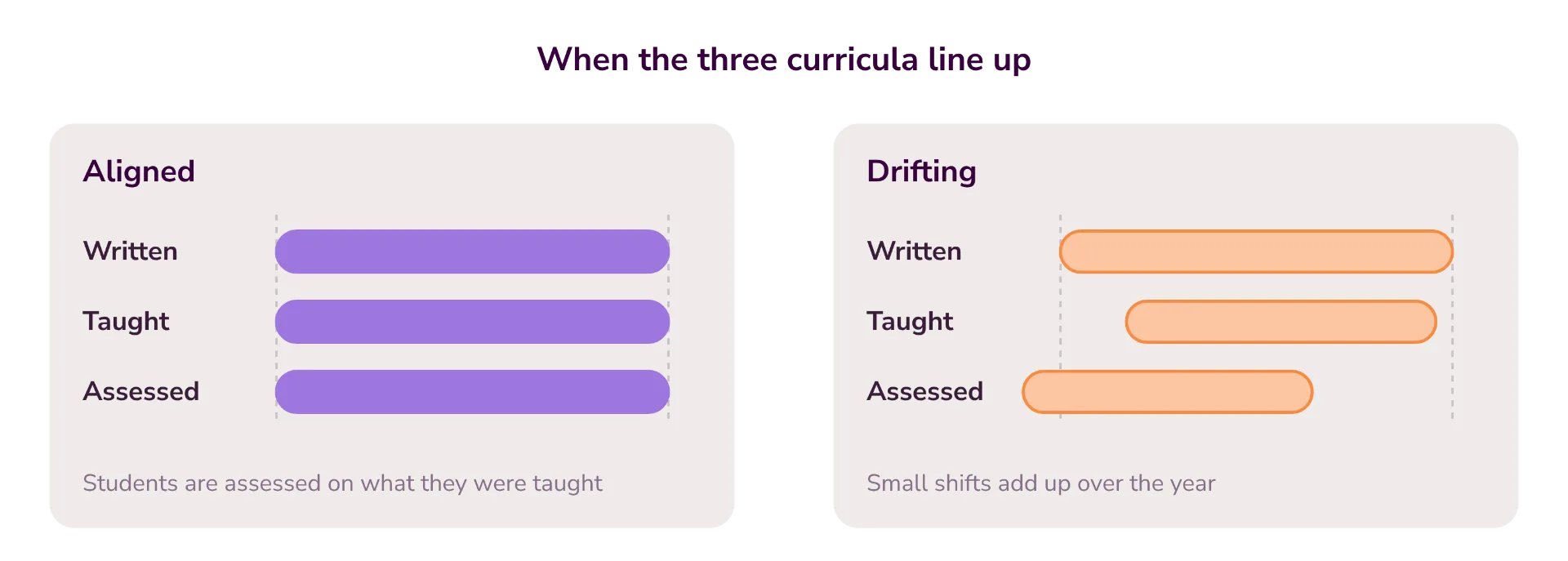
Written, taught, and assessed curriculum: aligned vs. drifting
The challenge is that small shifts can be hard to see from a school or district office until they add up. A spring data review might show that a core standard needs more attention. A curriculum review might ask for evidence of alignment that lives across several systems. Board reports and state monitoring raise the same question: how do we know what's being taught, and how well it's landing?
Many curriculum leaders approach this as a loop that runs through the year: plan, teach, assess, and grow. Here's what each stage looks like when it's working well, and where the right tools and support can help.
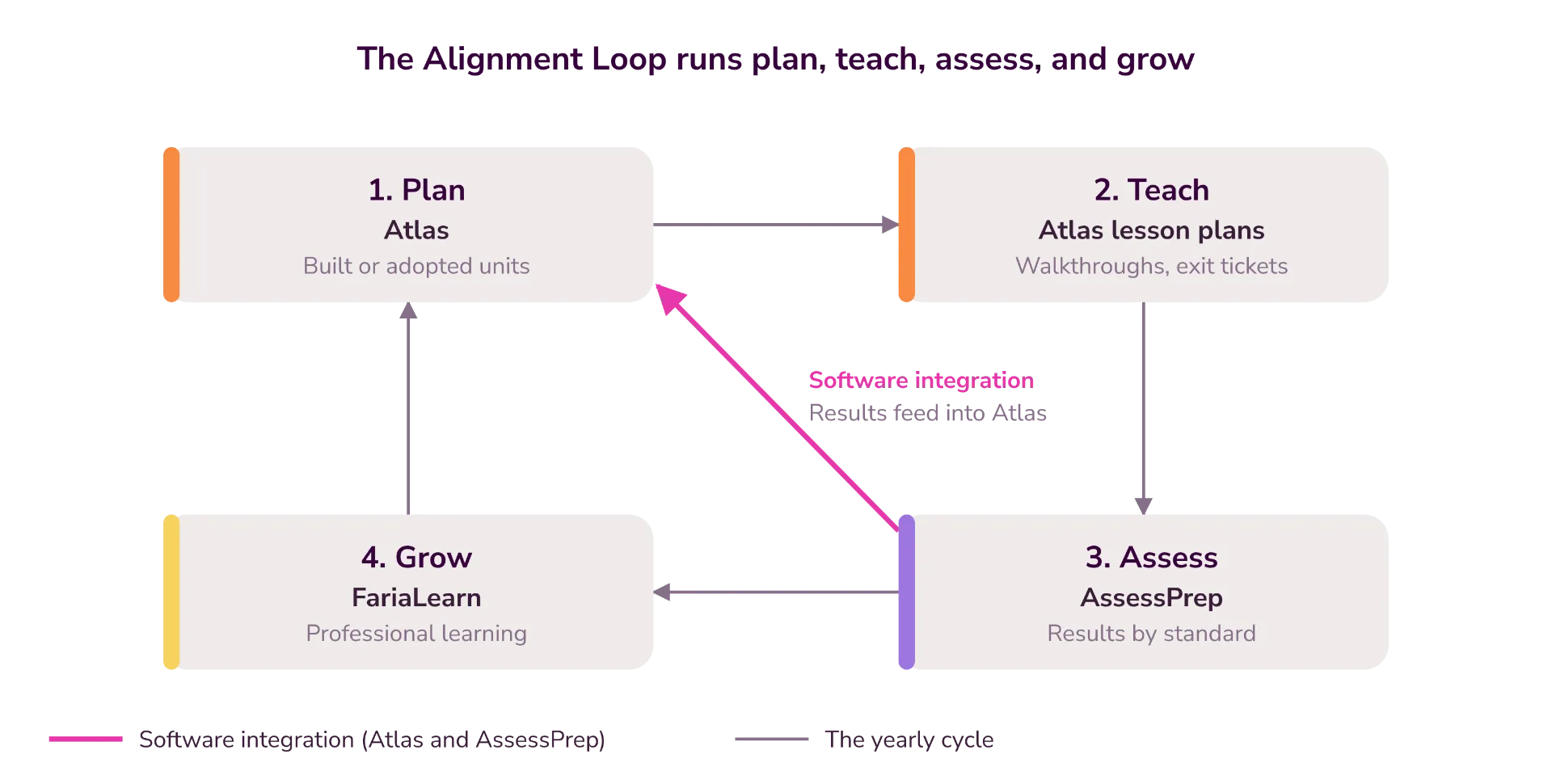
The Alignment Loop
1. Plan: Make the Intended Curriculum Visible
Whether you build your own units or adopt a program (HQIM, textbooks, etc), the intended curriculum needs to be visible and paced. Teachers need to know what's coming next, and leaders need to see how the pieces fit across grades, schools, and subjects.
When planning is shared, it becomes much easier to see whether eighth-grade science builds on seventh, or whether two sections of the same course are covering the same ground. Leaders can spot gaps and overlaps before the year starts, and new teachers can find what they need on day one.
How Atlas helps
Atlas supports instructional planning across a school or district. Teachers build units and lessons against standards, or work from an adopted program, and leaders get a clear view of pacing and coverage across the system.
The question to ask at this stage: if a new teacher joined tomorrow, could they see what students learned last year and what they're expected to learn next?
2. Teach: See How the Plan Comes to Life
The taught curriculum is where plans meet real classrooms, and it's often the hardest stage for leaders to see. Many districts now have strong curriculum materials and good assessment tools. Having invested in those materials, they want to know whether they're reaching classrooms as intended, how well they're being implemented, and where teachers need more support to use them well.
National data bears this out. In RAND's American Instructional Resources Survey, 55% of math teachers and 44% of ELA teachers said they regularly used standards-aligned materials in 2023-24, up from 31% and 15% in 2018-19. Teachers also adapt what they have to fit their students, and the average teacher draws on two core curricula and five supplemental resources.
This stage works best when it feels like a conversation with teachers rather than an inspection. A few practical sources of insight help:
Lesson plans in Atlas, which show how teachers are bringing units to life day to day and where pacing has shifted.
Classroom walkthroughs and coaching visits, which add the context that no document can capture.
Exit tickets and quick checks, which show teachers within a lesson or two whether an idea has landed.
Together, these give leaders an early, low-stakes view of implementation, long before end-of-unit results arrive.
The research on coaching is encouraging here. A meta-analysis of 60 studies found that coaching improved teachers' instruction by 0.49 standard deviations and student achievement by 0.18 (Kraft, Blazar, and Hogan, 2018).
The questions to ask at this stage: are the materials you've invested in being used in classrooms, and do you know how a unit is going while it's still being taught?
3. Assess: Measure What You Planned to Teach
Assessment is where the written and taught curriculum meet the evidence. When assessments are built from the plan, they show how well the plan is working for students, standard by standard.
Strong assessment at this stage does three things. It ties each question back to the standard it's meant to measure. It gets results to teachers quickly enough to adjust upcoming lessons while the unit is still fresh, which is where formative assessment does its best work. And it gives students a range of question types, so practice builds real confidence.
How AssessPrep helps
AssessPrep, an assessment platform, integrates with Atlas so that assessment results sit alongside the curriculum. In Atlas's Standards Overview, teachers can see where and when each standard is taught, which assessments measure it, and how students are performing against it. Assessments can run online, from open quizzes to a secure lockdown app, or on paper: teachers print QR-coded papers, scan completed work back in, and grade it digitally. Suggested grading helps along the way, and teachers review, adjust, or discard it, so they stay in charge of the mark.
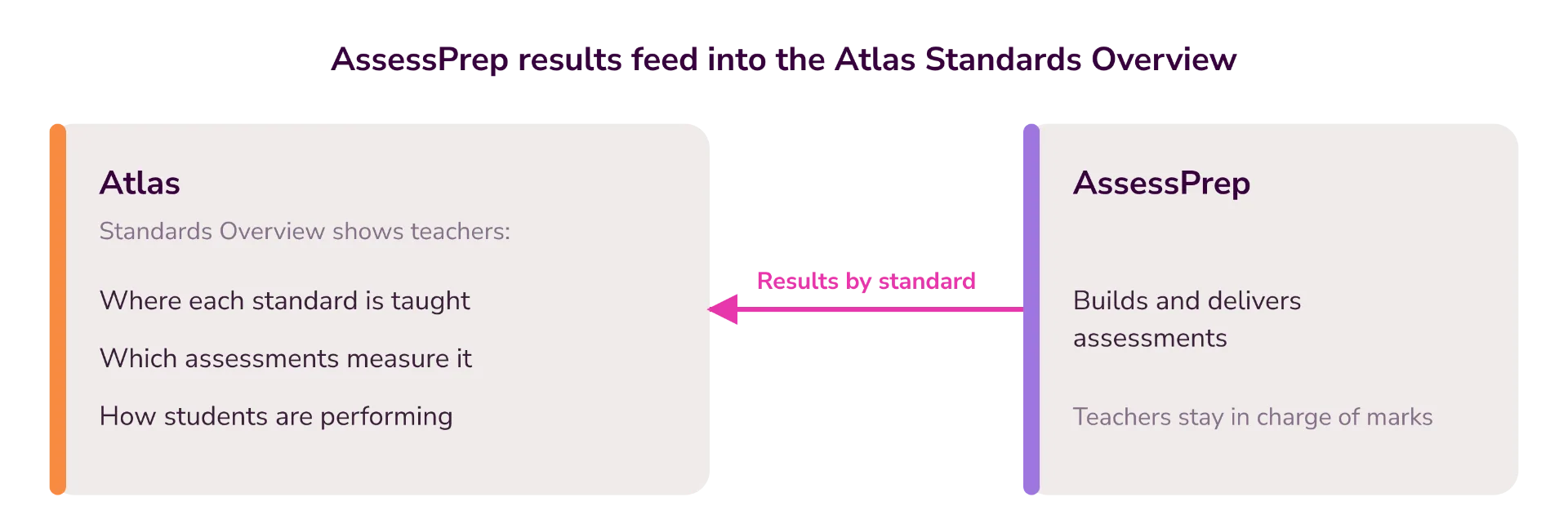
How Atlas and AssessPrep connect
AssessPrep also supports secure delivery, from open-browser quizzes to a lockdown app for formal assessments, and offers suggested grading that teachers review, adjust, or discard. The teacher stays in charge of the mark.
The questions to ask at this stage: can you trace an assessment question back to the unit and standard it's measuring, and how do formative results shape your upcoming instruction?
4. Grow: Turn Results Into Professional Learning
School calendars move fast. Results come in, grades go home, and the next unit is already underway. Finding time to reflect on what the evidence says about teaching is one of the most valuable things a team can do, and one of the hardest to protect.
The most useful question at this stage is what the results suggest about instruction. If a whole grade found the same standard difficult, that usually points to one planning or teaching question the team can explore together, and professional learning is often the most effective response.
This reflects what researchers are finding about new curriculum materials. A recent Kappan article argues that high-quality materials work best alongside curriculum-specific coaching, leader training, and protected time for teachers. With roughly 40% of schools lacking an instructional coach, flexible professional learning can help fill that gap.
How FariaLearn helps
FariaLearn offers professional learning in the format that suits the need: self-paced on-demand courses, or facilitated sessions delivered virtually or onsite. A department can respond to what the data shows without waiting for the next in-service day, and a teacher new to a framework can get up to speed before their first unit.
FariaLearn doesn't connect to assessment data directly, so curriculum leaders and teams decide what to focus on. FariaLearn gives them a place to go once they have.
Then the loop comes back around. Teachers bring what they've learned into the next round of planning, the next assessment measures the updated plan, and alignment improves a little more each cycle.
Building on the Work Schools Already Do
Every school and district has its own context, its own people, and its own way of doing things. The written, taught, and assessed curriculum will never line up perfectly, and they don't need to. What helps is a steady rhythm of planning, teaching, assessing, and learning that makes the gaps easier to see and easier to close.
Most teams are already doing much of this work, often with limited time and resources. RAND's 2023 State of the American Teacher survey found that teachers work about 53 hours a week on average, including 12 unpaid hours. The right combination of tools, support, and professional learning can make each stage a little lighter, so teachers and leaders can spend more of their energy on students.
If you'd like to explore what this could look like in your school or district, we'd love to help. Our team can walk you through how Atlas supports instructional planning, how AssessPrep results connect back to your curriculum, and how FariaLearn can support your teachers along the way, all shaped around the work you're already doing.