



If you're a curriculum leader, you've probably had this moment. Someone asks a question that should have a simple answer:
Are all of our teachers working from the same curriculum map this year?
Where are we teaching this standard across our middle schools?
How does our Grade 6 writing curriculum connect to what students learned in elementary school?
Are our assessments aligned across classrooms and school buildings?
You know the information exists somewhere. But finding it means opening dozens of documents, navigating shared drives, and piecing together the bigger picture from files scattered across departments and folders, sometimes spanning multiple school years.
Most districts didn't plan for their curriculum to become this fragmented. It happens gradually as teachers collaborate, new initiatives are introduced, and materials accumulate over time.
In this article, we'll explore what happens when curriculum lives primarily in documents, the hidden operational costs schools and districts often encounter, and how dedicated curriculum platforms like Atlas help leaders gain visibility across their entire instructional program.
Why Do Schools or Districts Turn to Google Docs?
At first glance, managing curriculum in Google Docs seems perfectly reasonable.
The tools are already available in most schools. They're easy to use, familiar to teachers, and make collaboration simple. A team can draft unit plans together, share instructional materials, and revise documents in real time without needing additional software.
For individual classrooms or small teams, this approach often works very well.
In fact, many strong curriculum resources are created this way. Teachers build thoughtful unit plans, refine lessons over time, and share materials with colleagues across their department.
But the challenge becomes apparent as the curriculum grows beyond individual classrooms.
As schools and districts expand and take on more grade levels and subject areas, the curriculum becomes less about individual documents and more about the relationships between them.
Leaders need to understand how standards connect across grades, how assessments align with instruction, and whether students across different schools are experiencing a coherent learning progression.
Documents can store curriculum materials. But they were never designed to show how the entire learning progression fits together.
What Happens When Your Curriculum Lives in Documents?
In most schools and districts, it's fair to say that curriculum systems develop gradually over time.
Departments adopt new instructional resources. Teachers create their own materials that live in shared folders. New initiatives introduce additional templates or planning structures.
While these decisions make sense in isolation, overtime, curriculum documentation can spread across dozens—or even hundreds—of files, folders, and platforms.
The result is not necessarily a lack of curriculum, but a lack of visibility into how the curriculum all fits together.
Here are some of the common problems that occur when your curriculum lives in documents:
1. Difficulty in Answering Simple Questions
We touched on this earlier. If a superintendent asked today, "Where are we teaching this standard across our middle schools?", many schools and districts would struggle to answer quickly. Curriculum materials may exist, but they are scattered across drives, documents, and departmental systems.
2. Institutional Knowledge Becomes Fragile
Curriculum expertise often lives in the experience of individual teachers who have refined units and lessons over many years. When educators retire, change roles, or move to another school, that knowledge can become difficult for others to access.
For schools and districts that have invested heavily in professional learning, collaborative planning time, and curriculum development, losing that accumulated expertise can represent a significant loss. Without a dedicated curriculum platform to capture and organize those insights, valuable instructional knowledge can disappear.
3. Student Outcomes Can Begin to Vary More Than Expected
When assessment and student learning results differ widely across classrooms or schools, the instinct is often to attribute the variation to teaching style or student demographics. In many cases, however, the underlying cause could be curriculum inconsistency.
Education researcher Robert Marzano describes the goal as a Guaranteed and Viable Curriculum (GVC), ensuring that every student has access to a coherent, high-quality learning experience regardless of which classroom they enter.
Research Shows Curriculum Fragmentation Is Common
These challenges are not unique to any one district.
Research from the RAND Corporation has shown that many teachers rely on a mix of instructional materials rather than a single curriculum source. In fact, a large proportion of teachers combine publisher resources with materials they create themselves.
While this flexibility supports teacher creativity and the ability to meet the needs of different learners, it can also make it difficult for leaders to maintain alignment across grade levels and subjects without a system that provides visibility into the curriculum as a whole.
As curriculum ecosystems become more complex, the need for structured, organized and transparent curriculum infrastructure becomes more apparent.
Want to learn more about what the RAND study reveals about curriculum alignment challenges in schools? Read our detailed guide.
What Changes When Your Curriculum Moves from Documents to a System?
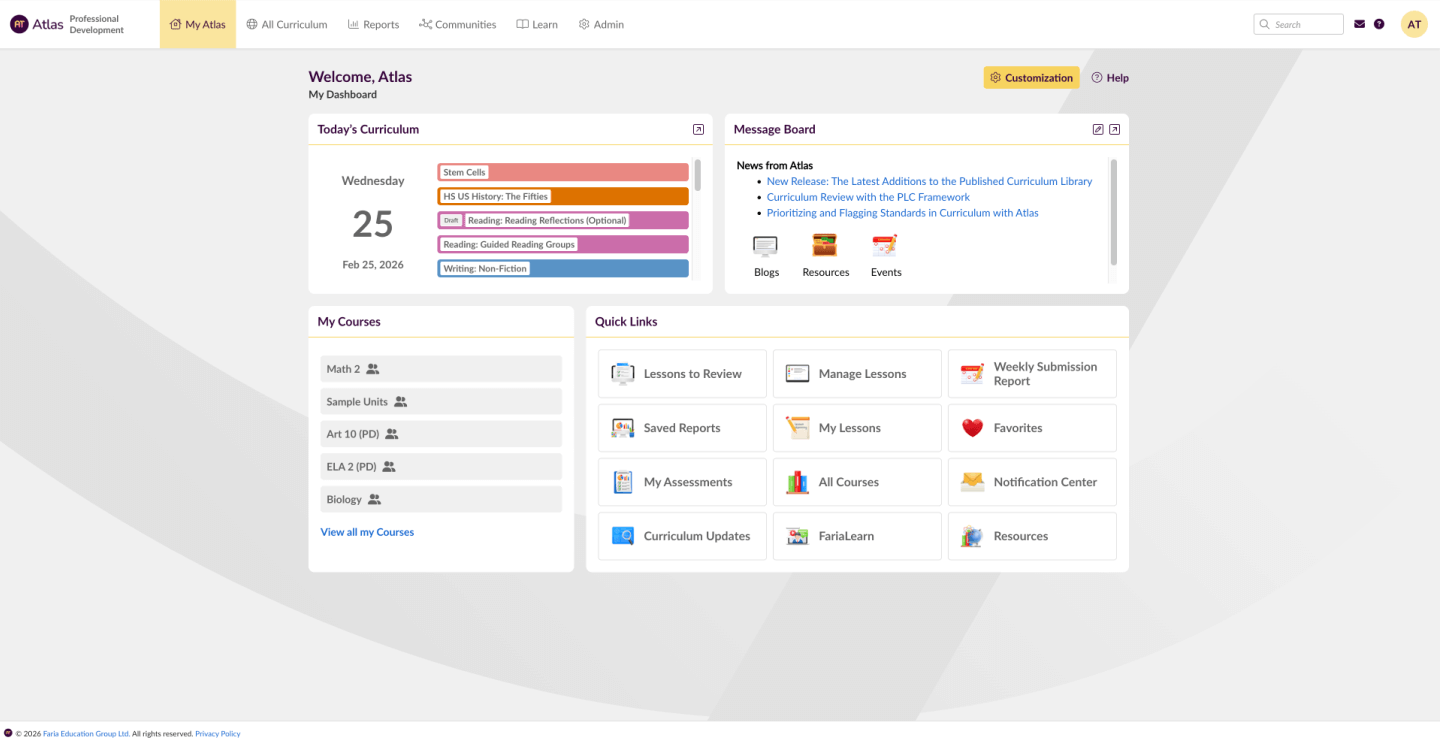
Document tools like Google Drive are designed to store and share files.
Curriculum management platforms serve a different purpose. Instead of storing individual documents, they organize the relationships between standards, instruction, and assessment across the entire school or district.
This difference may sound subtle, but it changes how curriculum can be accessed, utilized, understood, and improved.
Platforms like Atlas, used by districts around the world, are built specifically to help curriculum leaders manage these connections and gain visibility into the curriculum across their schools.
1. Curriculum Visibility Across Years and Subjects
One of the most powerful shifts is the ability to view curriculum vertically.
In document-based systems, teachers typically see only the materials they directly work with. Understanding how learning progresses across grade levels often requires manually reviewing dozens of documents.
A curriculum platform provides a bird's-eye view of the learning journey. Educators can see how courses, units, and lessons connect to what students learned previously and what they will encounter next.
2. Real Time Standards Tracking
Standards alignment is often managed manually when curriculum exists in documents.
Curriculum platforms allow districts to map standards directly to units and assessments, making it possible to analyze where standards are being taught and assessed and where unintentional gaps or redundancies may exist.
This transforms standards alignment from a periodic review process into something that can be monitored continuously.
3. Curriculum That's Easy to Find and Access
Teachers often spend valuable time searching through shared drives for curriculum resources.
Curriculum platforms replace folder navigation with structured search and reporting. Educators can locate benchmarks, essential questions, or instructional materials quickly, within a course, across a subject, or across the entire district.
This improves collaboration while reducing the time teachers spend looking for materials.
4. Consistency and Teacher Autonomy, Together
When curriculum planning happens in individual documents, formatting and structure often vary widely between classrooms.
Curriculum platforms allow districts to introduce shared templates that support consistent instructional design while still giving teachers flexibility in how they structure learning experiences.
The result is a shared pedagogical language without sacrificing teacher autonomy.
5. Protecting Institutional Knowledge
As previously mentioned, when curriculum lives primarily in individual documents, institutional knowledge can disappear when educators leave the district. Curriculum platforms help preserve that knowledge by ensuring planning, reflections, and revisions remain integrated within a shared system.
Over time, this allows districts to build and refine curriculum collaboratively rather than repeatedly starting from scratch.
6. Supporting Continuous Curriculum Improvement
In many districts, curriculum review occurs periodically during formal curriculum cycles.
Curriculum platforms allow this process to become ongoing. Feedback, reflections, and revisions can happen continuously, enabling your curriculum to evolve based on teacher insight and student outcomes.
Rather than remaining static documents, your curriculum becomes a living system.
Case Snapshot: Randolph Township School District
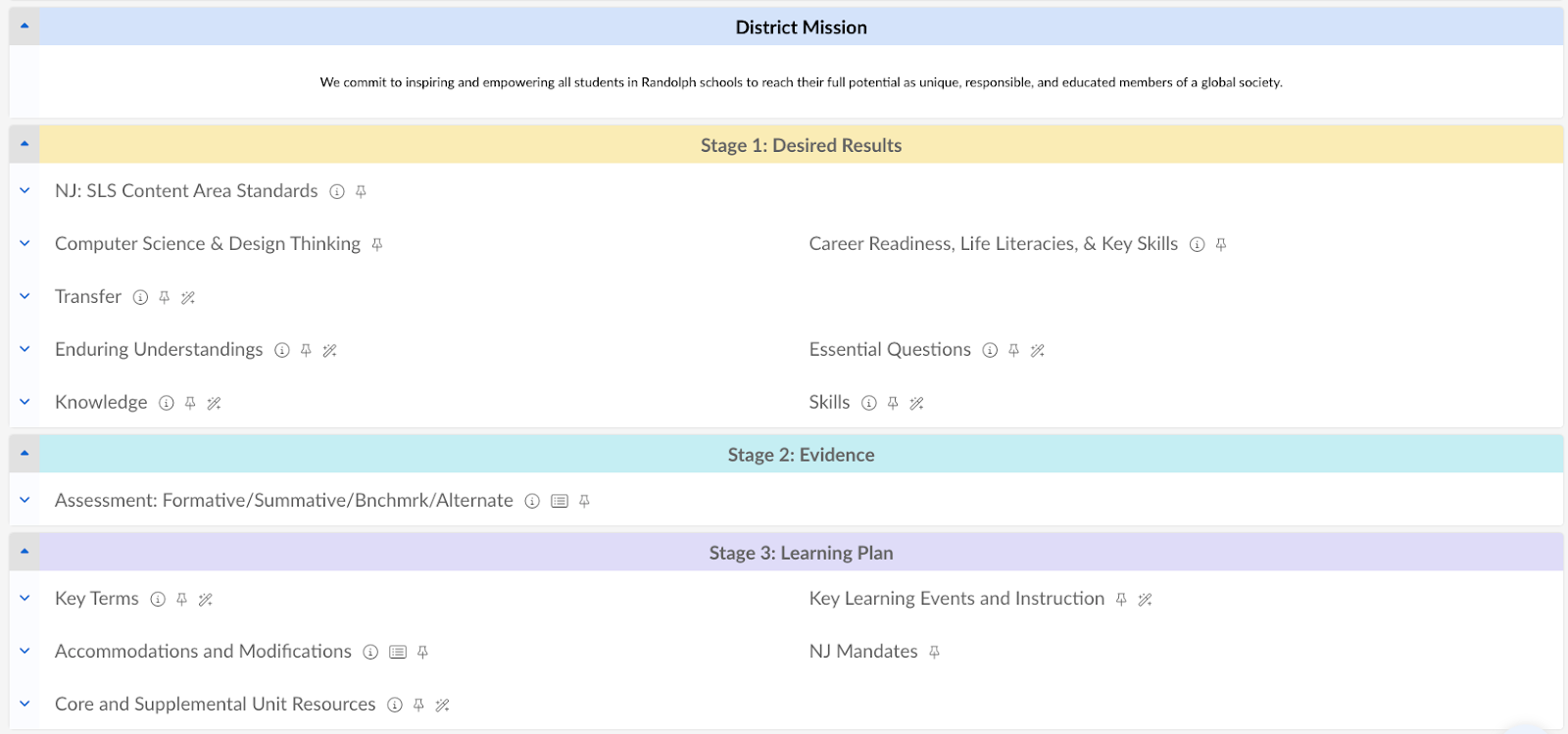
Randolph's unit template in Atlas is aligned with QSAC requirements, keeping consistency across all courses throughout their curriculum.
Randolph Township School District in New Jersey faced a challenge familiar to many districts.
Over time, curriculum documentation accumulated across hundreds of files stored in multiple locations. Teachers and administrators often spent significant time searching for materials rather than improving instruction.
District leaders recognised that limited visibility into curriculum was making it difficult to support alignment across schools and meet state review requirements.
By consolidating more than 350 curriculum documents into a single structured system, the district was able to improve visibility, strengthen alignment across grade levels, and support ongoing curriculum review.
(You can read the full Randolph Township case study here.)
At What Point Do Documents Stop Being Enough for Curriculum?
The shift from Google Docs to a curriculum platform usually happens when leaders recognize that their existing system can no longer answer the questions they need to manage teaching & learningacross the district.
Often, that moment arrives during initiatives such as:
Preparing for state curriculum reviews or accreditation visit
Introducing new standards, initiatives, or instructional frameworks
Trying to understand why student outcomes vary across schools
Attempting to align curriculum vertically across grade levels or strengthen connections across disciplines
At that stage, the challenge is no longer creating curriculum materials. Districts already have them.
The challenge is seeing how those materials connect across the system.
Leaders need to understand where standards are taught, how assessments align with instruction, and whether students experience a coherent progression, both as they move from one grade level to the next and across the different subjects they encounter.
This is the point where many districts begin looking for curriculum infrastructure designed specifically for that level of visibility.
Curriculum platforms provide that structure by allowing districts to map standards, organize instructional units, and analyze curriculum alignment across schools within a single system.
So What's the Real Cost of Google Docs vs Curriculum Platforms?
Tools like Google Docs appear to be a low-cost way to manage curriculum; though districts typically pay for storage as their files multiply.
But the real comparison isn't between free software and paid software. It's between documents and systems.
Document tools are designed to create and store files. They work well for drafting lessons, sharing resources, and collaborating on unit plans.
Curriculum, however, operates at a different level. The questions that matter most—how standards connect across grades, whether assessments align with instruction, whether students in different classrooms are getting a coherent experience—require more than a file system can offer.
When your curriculum lives primarily in documents, those connections are difficult to see. Answering system-level questions often requires manually reviewing multiple files across departments and grade levels, and even then they may still struggle to find what they are looking for
Curriculum platforms approach the problem differently. Instead of storing curriculum as individual documents, they organize the relationships between standards, instruction, and assessment across the district.
In that sense, the real cost of managing curriculum in documents isn't the price of the tools; It's the lack of visibility into the curriculum system itself.